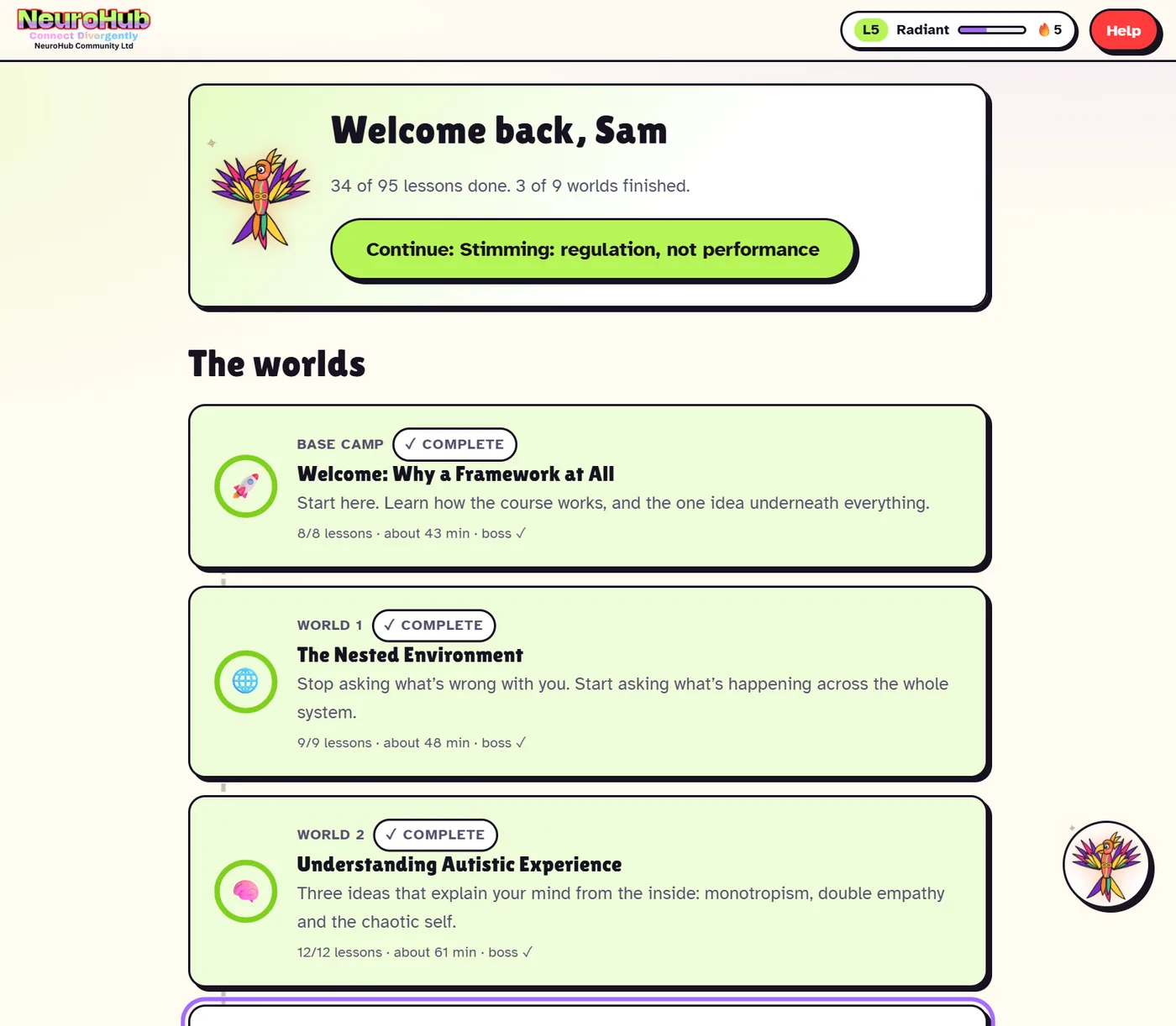
A course by David Gray-Hammond and Helen Edgar, NeuroHub Connect

Building a PositiveAutistic Identity

A gentle, self-paced space to understand your mind and bodymind, care for your wellbeing, and grow into an identity that feels like home. Created from inside our Autistic community.

  • 9 worlds to explore, with stories, playful activities, real-life scenarios and quiet reflection (about 8.5 hours, at your own pace)
  • Check-ins that chart your growth in wellbeing and sense of identity, then a Growth Journal PDF to keep
  • Phoenix, your AI companion, animated, and you can talk to it by voice or type
  • No timers, no deadlines, no pressure. Pause whenever you need; nothing here expires. Sensory-friendly settings, calm theme, reduced motion, hide the game entirely
Try a free lesson

One payment. No subscription. Access starts straight away and works on any device. Launch price £60 for the first 25 subscribers (until 1 April 2027).

The course map: nine worlds with progress rings, a Continue button and a friendly phoenix mascot.
  • 9worlds to explore
  • 95short explorations
  • ~8.5hat your own pace
Why this course

So much of what’s written about autism describes us from the outside.

This course begins from the inside. Written by David Gray-Hammond and Helen Edgar and adapted from Supporting Autistic People: A Six-Point Framework, it holds no compliance techniques, no “fixing” and no encouragement to mask. Instead it gently turns attention to the environments, relationships and systems around you, and honours you as the expert on your own life.

Being

Understand your mind

Monotropism, the double empathy problem and the chaotic self help explain why transitions cost so much, why capacity changes day to day, and why communication can break down in both directions.
Care for your wellbeing

Explore the eight senses, sensory overload, meltdowns and shutdowns, and Autistic burnout: how to notice it early, why partial fixes often aren’t enough, and what recovery needs.

Belonging

Feel safe

Understand how chronic, everyday harm becomes trauma, then explore what genuine safety is made of and how to ask for it, from predictability to repair.

Find your people

Discover the history of Autistic self-advocacy, weigh community wisdom alongside professional advice, and, when you’re ready, step into community at your own pace.

Becoming

Grow your identity

Find words that fit you, gently let go of labels that never described you, make sense of late identification, and understand masking as a survival response, never a personal failing.

Notice your growth

Wellbeing and identity check-ins, charted from day one, then a Growth Journal PDF of everything you reflected on and how you changed.

See inside

Real screens from the real course

These are screenshots of the actual app. Every lesson is a stack of short cards you move through at your own pace.
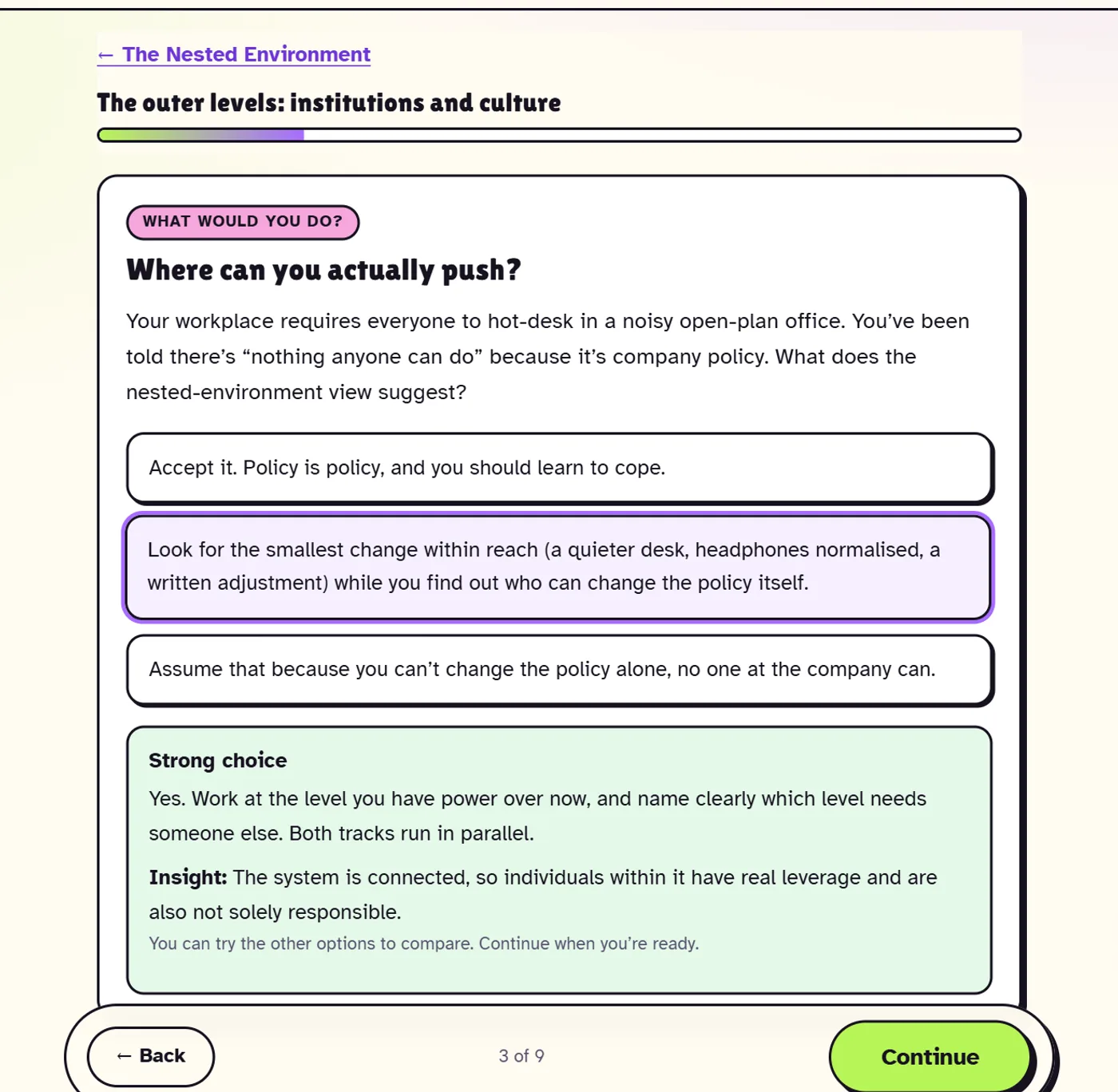
A scenario card: what would you do when a workplace says nothing can be changed? Three choices, with a strong choice explained.

Scenarios that feel like real life

Work, school, healthcare, friendships and self-talk. Choose what you would do, then see why each choice does or doesn’t work, in the book’s terms. Nobody is shamed for a “wrong” answer, and you can try every option.
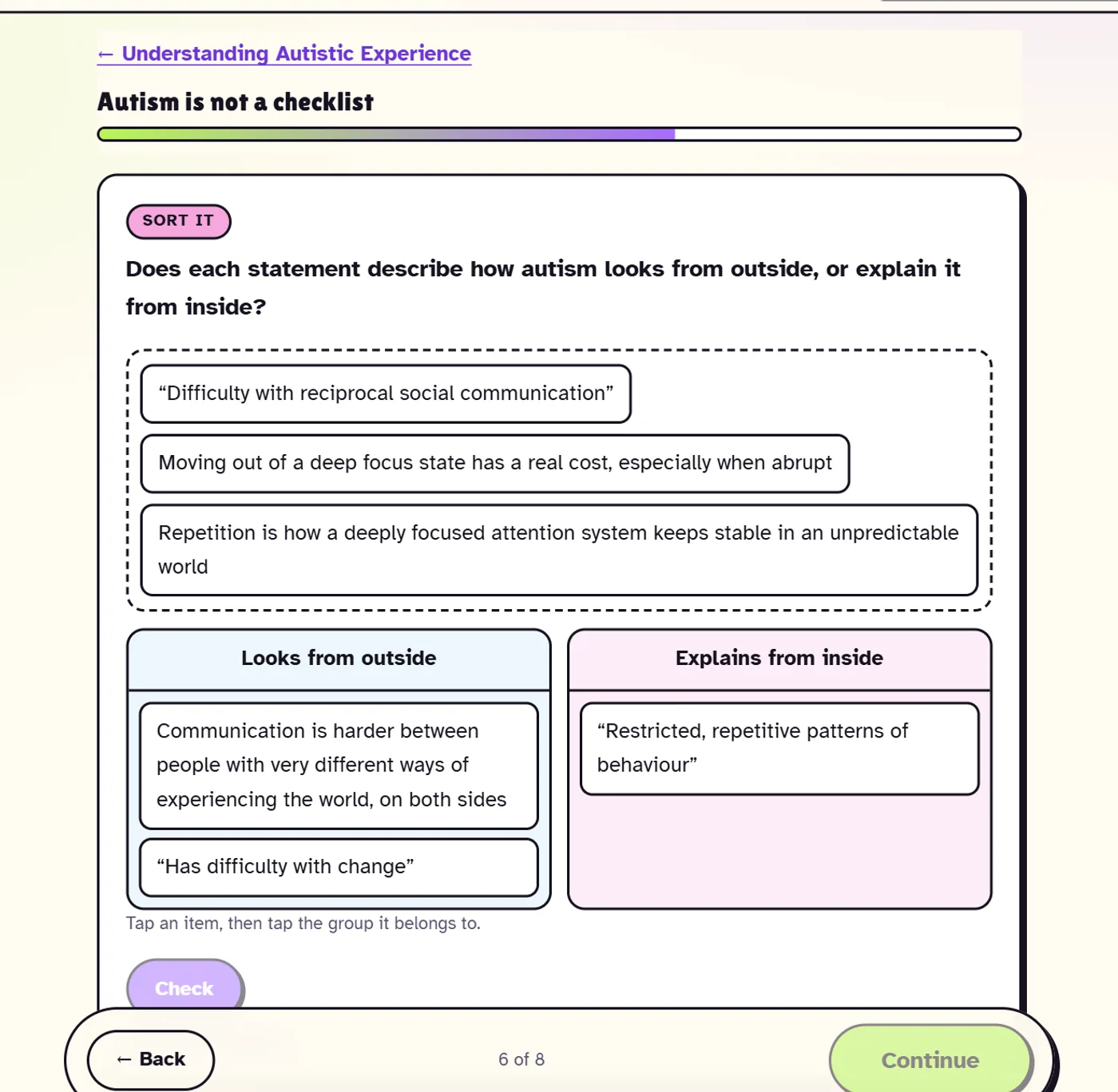
A sorting activity: decide whether each statement describes autism from outside or explains it from inside.

Sort, match, order and explore

Eighteen kinds of activity, so you can learn in the ways that suit you: sorting, matching, flip cards, myth-busting and more. Everything works by tap or keyboard.
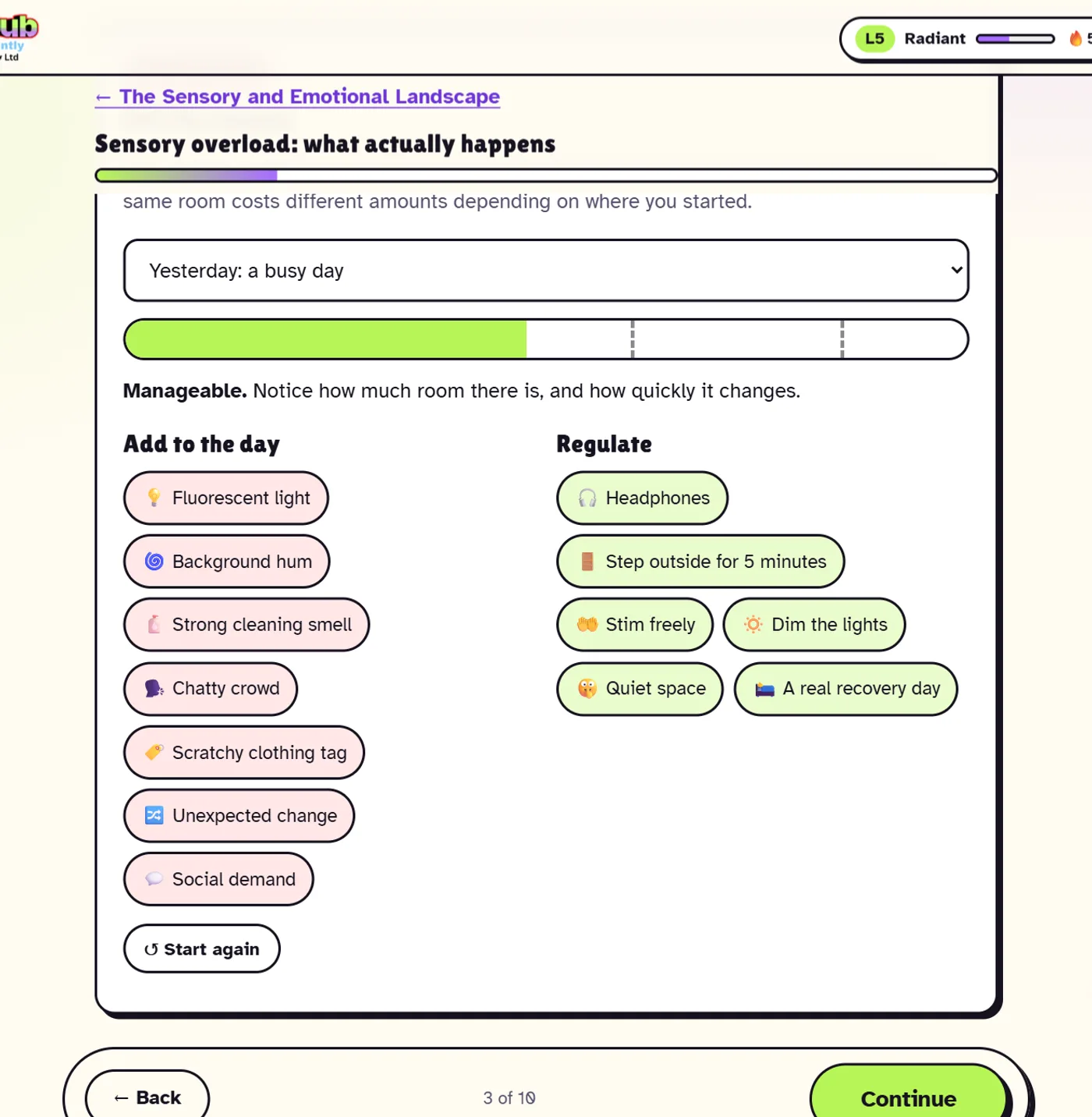
An interactive sensory load meter with stimuli to add and ways to regulate, showing how load is additive.

Playable models of the big ideas

Six interactives: nested environments, attention beams, a sensory load meter, the burnout loop, an energy battery and a safety builder. Feel, in a hands-on way, why “nothing happened” is so rarely the whole story.
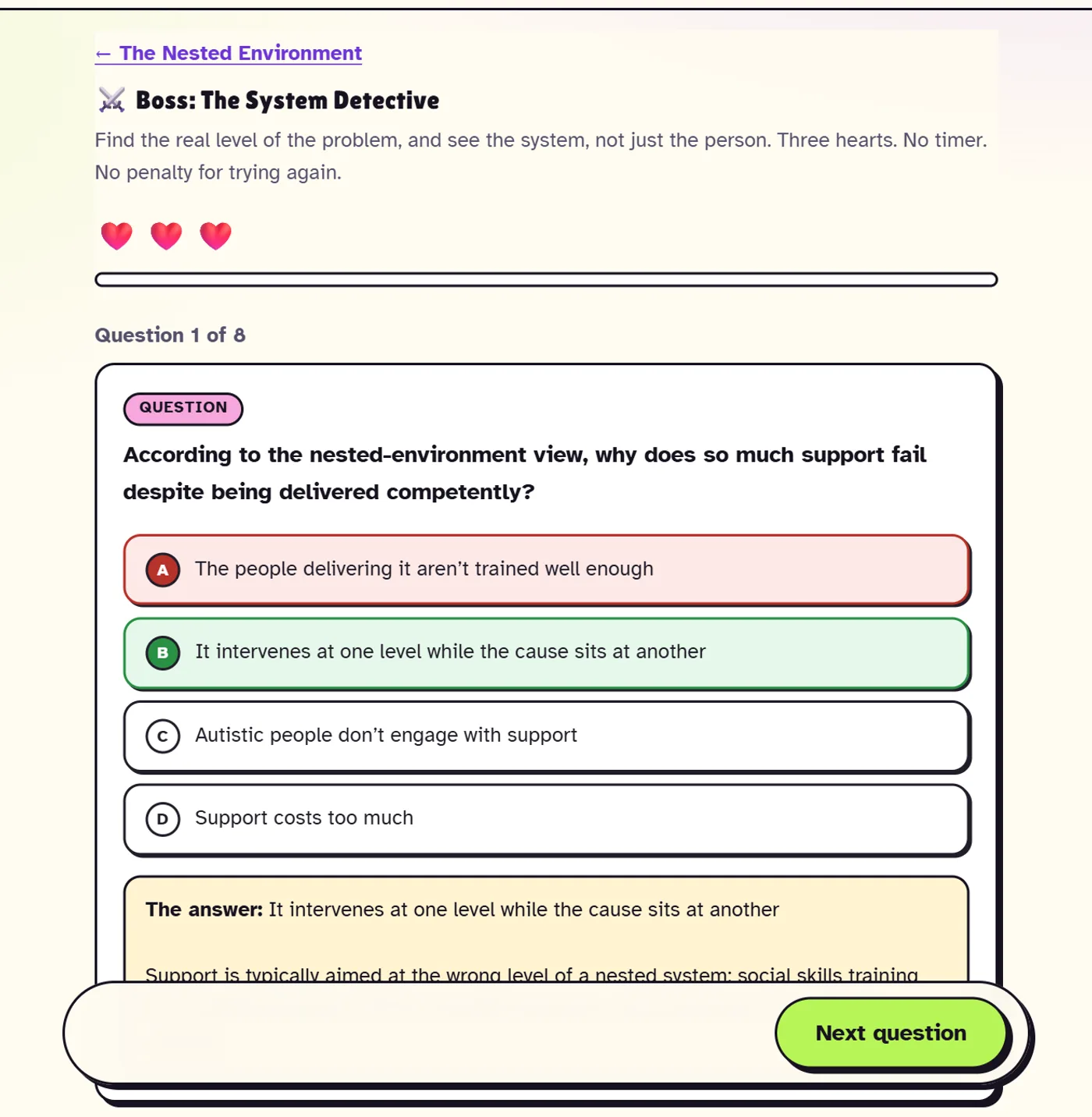
A Gathering with three hearts and a question about the nested environment.

Gatherings, with no punishment

Each world closes with a gentle chance to bring everything together. You get three hearts and as many tries as you like, and if it doesn’t go your way the course invites you to pause and breathe.
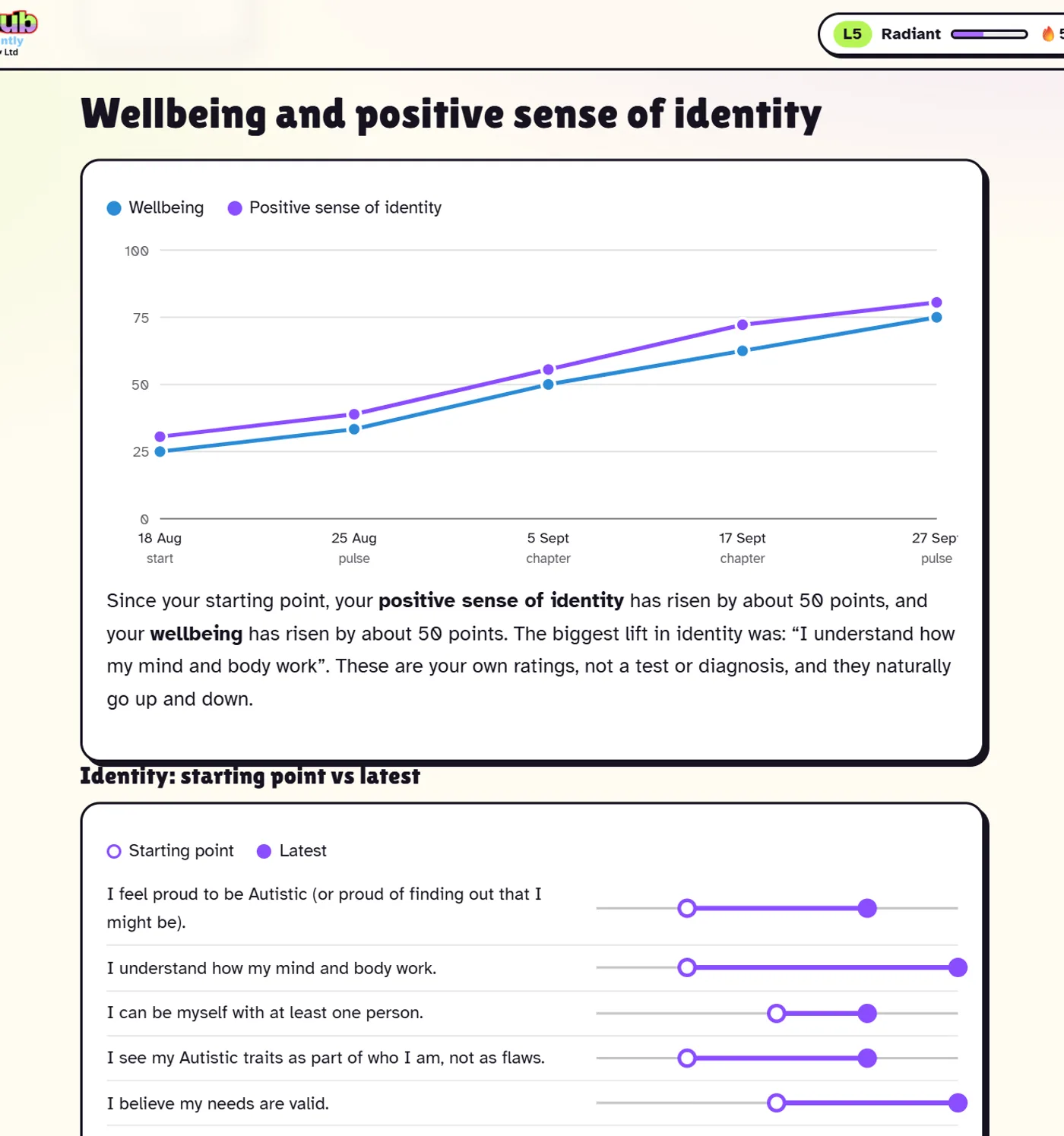
A progress page charting wellbeing and positive sense of identity over five check-ins, both rising.

Notice your own growth

Short wellbeing and Positive Sense of Identity check-ins are charted over time, with gentle, honest notes about what moved. These are reflections for you, not a test.
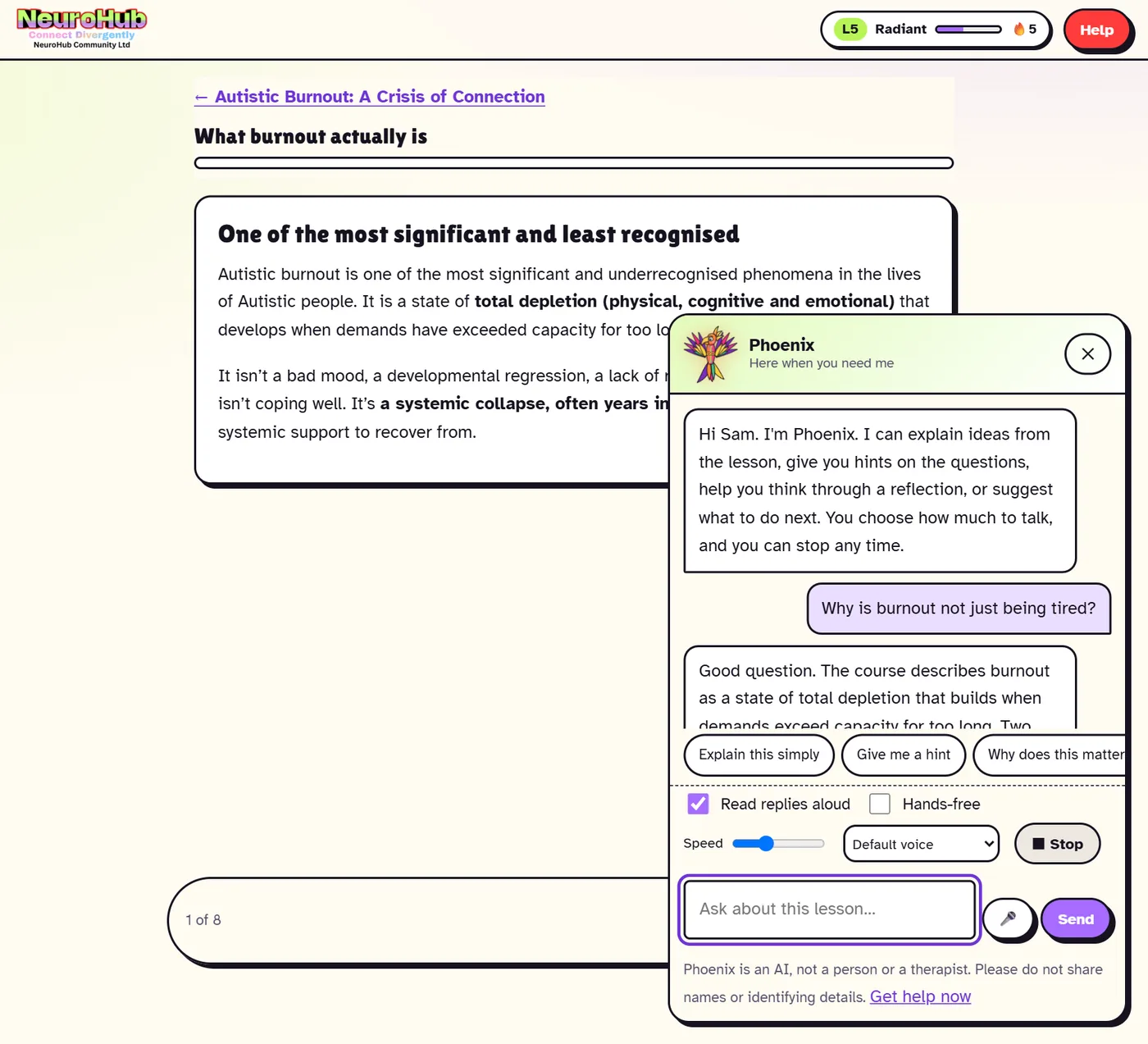
Phoenix, the AI companion, answering a question about burnout in a chat panel with voice controls.

Phoenix: ask, talk, get unstuck

An animated AI companion who knows exactly which lesson you are on. Ask for a hint before an answer, an explanation, a word defined, or a nudge on what to do next. Switch on voice and it will listen and speak. Every reply that draws on a NeuroHub article links to it.
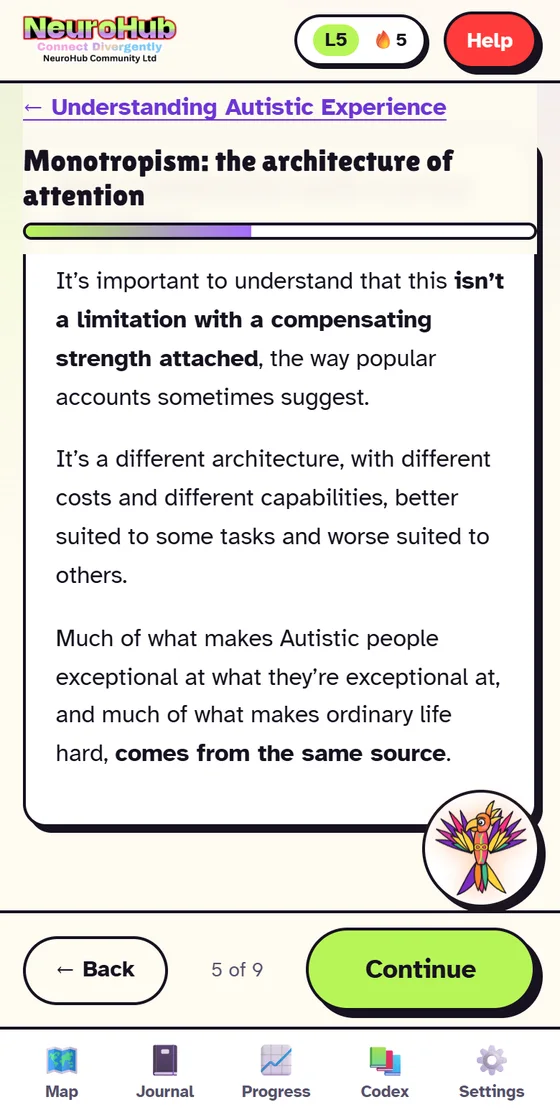
A lesson card on a phone screen.

Works on your phone

Lessons are made of small cards, so they work just as well on a phone. Add it to your home screen and pick up where you left off on any device.

What’s inside

Nine worlds to wander in order, or dip into as you need

Base camp: Welcome: Why a Framework at All8 lessons · about 43 minutes · Gathering

A good place to begin: how the course works, and the one idea that runs beneath everything.

  1. How this course works — The map, the game, the journal, the check-ins, and how to make it all fit your energy.
  2. A word from the author — Why the book exists, what it refuses to be, and the language it uses.
  3. How to use this course — Why the six foundations build in a sequence, and how to use the course when something specific is going on.
  4. Why a framework at all? — Fragments that contradict each other, and what a framework does that tips can’t.
  5. The six foundations, at a glance — A first look at each of the six foundations and what each one is really about.
  6. The shift: from correction to connection — The single reorientation underneath the whole framework, and why it’s about accuracy, not just kindness.
  7. Who this is for, and the honest limits — Who the framework is written for, and what no framework can do.
  8. Reflect: Setting your intention — A few private questions to mark where you’re starting from.
World 1: The Nested Environment9 lessons · about 49 minutes · Gathering

Shifting the question from “what’s wrong with me?” to “what’s happening around me?”

  1. A way of re-storying — Nested environments, and why so much support aims at the wrong layer.
  2. The inner levels: body, surroundings, relationships — The Autistic body, the sensory and relational immediate, and relationships and roles.
  3. The outer levels: institutions and culture — Where so much Autistic distress begins, and where change is still possible.
  4. Why “no discrete boundaries” matters — Mycelium, not architecture: how a political decision becomes a moment of cortisol.
  5. Multi-directional influence — Influence travels in every direction, and protects against two opposite errors.
  6. Time: the sixth dimension — Everything in this ecology has a history, and consistency compounds.
  7. Using the model in practice — The five-level diagnostic habit and what this chapter changes.
  8. Try it: Practical Steps — Nine concrete things to try this week.
  9. Reflect: Your Questions — Five slower questions for honest private thinking.
World 2: Understanding Autistic Experience12 lessons · about 61 minutes · Gathering

Three ideas that explain your mind from the inside: monotropism, double empathy and the chaotic self.

  1. Autism is not a checklist — Why the deficit account was wrong, and why the criteria describe only the surface.
  2. Monotropism: the architecture of attention — Attention is finite and minds distribute it differently. Yours runs deep on fewer channels.
  3. What follows from monotropism — Why transitions, interests, demand stacking, routine and starting things work the way they do.
  4. Working with your architecture — Arranging environments, routines and expectations to work with the way your attention works.
  5. The double empathy problem — Communication breakdowns are mutual. The gap lies between two ways of being.
  6. Double empathy in practice, and where it bites hardest — Directness, shared repair, and three places the gap does the most damage.
  7. The chaotic self — Why your identity and capacity aren’t fixed, and why that isn’t instability.
  8. What follows from the chaotic self — Capacity varies, context matters, masking hides it, and the only stable arrangement is one that expects variation.
  9. Beyond the three frameworks — Bottom-up processing, pattern recognition, processing delay, justice sensitivity and inertia.
  10. Seeing the world through an Autistic lens — How the three frameworks interlock, and the shift from correction to connection.
  11. Try it: Practical Steps — Twelve concrete things to try, turned to face your own life.
  12. Reflect: Your Questions — Six slower questions, re-aimed at your own life.
World 3: The Sensory and Emotional Landscape12 lessons · about 65 minutes · Gathering

Eight senses, one bodymind. Listening gently to what your nervous system has been telling you.

  1. A different bodymind — Why wellbeing is inseparable from the body, and why “bodymind” is the right word.
  2. The five familiar senses — Vision, sound, smell, taste and touch: hyper, hypo, and both at once.
  3. Proprioception and the vestibular system — The senses of where your body is and how it moves, and why movement regulates.
  4. Interoception: the sense that tells you how you are — Hunger, thirst, pain, emotion. Why “I don’t know” can be the exact truth.
  5. Sensory overload: what actually happens — Overload is additive, carried forward, and not fully preventable, so recovery is the point.
  6. Stimming: regulation, not performance — A tool, not a symptom, and why suppressing it does harm.
  7. Eye contact — The most targeted behaviour with the thinnest case, and what to do instead.
  8. Seeking and avoiding — Two directions of sensory behaviour, often in the same person within minutes.
  9. Meltdowns and shutdowns — Two presentations of the same overwhelm, and why recovery comes first.
  10. What the sensory landscape explains — A lot of “behaviour, personality and attitude” turns out to be sensory.
  11. Try it: Practical Steps — Fifteen steps, turned to face your own life.
  12. Reflect: Your Questions — Six slower questions, re-aimed at your own life.
World 4: Autistic Burnout: A Crisis of Connection13 lessons · about 63 minutes · Gathering

Not a bad mood, and never a weakness. Burnout is a response to an unsustainable world, and recovery is possible.

  1. What burnout actually is — A systemic collapse, not a bad mood, and not something that happens inside you.
  2. The causes I: masking and sensory load — The masking load, and the absence of discharge from cumulative sensory load.
  3. The causes II: demand overload and invalidation — Why the demand profile matters as much as the quantity, and how being disbelieved injures.
  4. The loop — Why burnout rarely resolves on its own and why partial fixes fail.
  5. What burnout looks like — Seven common presentations, and why it is so often misread.
  6. Recovery: what it requires, and reconnecting to the body — A genuine reduction in demands, four domains of reconnection, and starting with the body.
  7. Reconnecting to daily life: pacing — Pacing, the boom-and-bust trap of good days, and why setbacks aren’t failures.
  8. Reconnecting to community and to your Autistic identity — Gentle reconnection at your own readiness, and why a positive identity is part of the treatment.
  9. Burnout in children and young people — Why school environments so often lead to burnout, and what can help.
  10. Prevention: building sustainable environments — Prevention is cheaper than recovery in every currency.
  11. When someone is in it — What to do this week, for yourself or for someone you support.
  12. Try it: Practical Steps — Thirteen steps, turned to face your own life.
  13. Reflect: Your Questions — Six slower questions, re-aimed at your own life.
World 5: Identity, Language, and Disability Models11 lessons · about 62 minutes · Gathering

The words we use shape where we place the difficulty, and who is asked to change.

  1. Why language matters — Language is respect and precision, and encodes where problems are located.
  2. Identity-first and person-first language — Two conventions, what the community prefers, and the individual’s right to choose.
  3. The harm of functioning labels — Six problems with “high-” and “low-functioning”, and what to say instead.
  4. The medical model and the social model — Where disability is located, and why the social model should be the primary lens.
  5. Neurodivergence as a socio-political identity — What the neurodiversity paradigm claims and doesn’t, and why identity doesn’t start with diagnosis.
  6. Late diagnosis and the building of identity — Grief and relief together, unmasking, and why burnout usually needs addressing first.
  7. Intersectionality and unequal recognition — Who gets recognised as Autistic, who gets believed, and how the framework applies unevenly.
  8. Self-identification — Why self-identification is valid, and what to do about diagnosis.
  9. Language lab: take the words back — An applied lesson: reframing labels into specific, accurate, affirming language.
  10. Try it: Practical Steps — Twelve steps, turned to face your own life.
  11. Reflect: Your Questions — Six slower questions, re-aimed at your own life.
World 6: Trauma, Safety, and the Emotional Environment12 lessons · about 65 minutes · Gathering

Safety is the foundation everything grows from, and it can be built with care.

  1. Safety is not a luxury — Why safety is the foundation, and why it can’t be assumed.
  2. Understanding Autistic trauma — Chronic, relational, systemic trauma, and why there may be no single event.
  3. Sources of Autistic trauma — Ten sources, named plainly, and the point that many aren’t inevitable.
  4. Masking as a trauma response — Why masking isn’t a social skill, and why unmasking must be yours to do.
  5. What genuine safety is: trauma-informed, and predictable — Environments, not just training, and predictability as a kindness to a threat-primed nervous system.
  6. Sensory safety, autonomy and choice — Sensory needs as a safety issue, and why refusal is information.
  7. Co-regulation, retreat and rest — Regulation happens in relationship, and it’s always all right to need space.
  8. Restraint, seclusion and coercive care — Some harms need naming directly. A careful look at how they happen and how they’re avoided.
  9. Relational safety: trust and repair — Trust is built by consistency and belief, and repair builds evidence that things get addressed.
  10. Safety builder — Put the components together and see what happens to safety.
  11. Try it: Practical Steps — Thirteen steps, turned to face your own life.
  12. Reflect: Your Questions — Six slower questions, re-aimed at your own life.
World 7: Learning From Autistic Community12 lessons · about 62 minutes · Gathering

You are not alone, and you never were. Community is where so much of our knowledge lives.

  1. The most important source of knowledge — Autistic people are the primary experts, and were systematically excluded from the conversation.
  2. The history of Autistic self-advocacy — From Autism Network International in 1992 to a global movement, and where our concepts came from.
  3. What community offers: wisdom and language — Knowledge from inside, and words that turn “I’m broken” into “I’m in burnout”.
  4. What community offers: norms and solidarity — Sensory-friendly spaces, shared meaning, and why belonging protects mental health.
  5. Nothing About Us Without Us — Being centred with real power, and why unpaid expertise is a harm, not a compliment.
  6. How to engage authentically — Humility, tolerating anger, and seeking out the range of Autistic voices.
  7. When community knowledge and professional advice conflict — Five practical ways to weigh two bodies of knowledge, and a default for when you can’t resolve it.
  8. Community is not optional — A health issue, not a nice-to-have, and many ways to belong at your own pace.
  9. Find your people: the NeuroHub online community — An open door to our online community, and how to use any community at your own pace.
  10. The function of this foundation — Why community comes last: it’s the error-correction process that keeps everything else honest.
  11. Try it: Practical Steps — Eleven steps, turned to face your own life.
  12. Reflect: Your Questions — Six slower questions, re-aimed at your own life.
World 8: Putting the Framework to Work6 lessons · about 39 minutes · Gathering

Use the six foundations as a lens on your own life, and leave with your own words, your own plan, and a sense of what comes next.

  1. The six foundations as a lens — A support framework and an assessment framework: examine the ecology, not just the person.
  2. Your own six-foundations check-up — An applied lesson: run the six lenses on your own life and choose two things to change.
  3. Where the foundations meet reality — The real constraints, what costs nothing, the economic argument, and when advocacy is the answer.
  4. The limits of frameworks — Three cautions: patterns aren’t people, frameworks can be performed, and this one will need revision.
  5. Why this framework matters — What Autistic people actually thrive through, and what each foundation asks of us.
  6. Your identity statement and plan — A capstone: your own words, your commitments, and a note to your future self.

Each world closes with Try it (small, optional ideas to explore when you have capacity) and Reflect (slower questions to sit with, privately, in your own time).

Comfort first

Designed around how many Autistic and ADHD people learn

  • No timers, no fail screens. Retries are free, streaks are optional, nothing bad happens if you take a month off. Rest is part of learning.
  • Sensory settings: reduced motion, a soft “calm” theme, dark mode, text size, and sound that never plays by itself.
  • Hide the game entirely if you would rather just learn. The content stays the same.
  • Content notes before heavy chapters, and a permanent Help button with text and chat options worldwide.
  • Clear, literal language, short cards, and the chance to pause at any point.
Check-ins and your Growth Journal

Notice how you grow

Most courses tell you what you learned. This one also shows you what changed. At the start, and at points along the way, you complete two short check-ins: one about your wellbeing, one about your positive sense of identity. They are charted over time, and when you finish you can download a Growth Journal PDF with your reflections, your commitments, your badges and both charts.

It is built on your own device, so your private reflections do not have to leave it.

Meet Phoenix

An AI companion that rises with you, at your pace

Phoenix grows brighter as you level up. It is there when you want it, quiet when you don’t, and honest about being an AI.

Knows where you are

It reads the lesson you are on, so answers are grounded in the course, not generic advice. It gives hints before answers.

Talk or type

Turn on voice to speak your questions and hear the answers, with live captions. Off by default, and nothing plays without you.

Draws on our blog

Phoenix can search 490 articles from NeuroHub Connect and link the ones it uses, so you can read more.

Safety first

If you mention crisis or harm, Phoenix stops teaching and points you to real people, with numbers for your country and text options, not only phone lines.

Get the course

One payment. Everything included.

£80 one payment

Launch price: £60 instead of £80

Launch price for the first 25 customers

Subscribe to launch news by email or web push and the one-off price drops from £80 to £60 at checkout. Choose either one, or both. The launch price is for the first 25 customers, and is available until 1 April 2027.

or

  • All 9 worlds and 95 lessons (about 8.5 hours)
  • Gatherings, badges, levels and the Codex
  • Wellbeing and identity check-ins with progress charts
  • Phoenix AI companion, with optional voice
  • Your Growth Journal PDF and a certificate on completion
  • Works on phone, tablet and computer, progress synced

Prefer to spread the cost? Pay monthly

£15 a month with a minimum commitment of 6 monthly payments (£90 in total). After that you can cancel any time from Settings in the course and keep access to the end of the month you have paid for.

Secure payment by Stripe. Access starts immediately, so all purchases are final (see our Terms and refunds). Or try a free lesson first.

Written from inside

Written from inside our community

This course is co-created by David Gray-Hammond and Helen Edgar, Autistic writers, trainers and advocates at NeuroHub Connect. David brings years as a practitioner and as someone on the receiving end of services that believed they were helping. Helen is Co-Creative Director of NeuroHub Connect and the founder of Autistic Realms and More Realms. A late-identified AuDHD parent of two neurodivergent children and a former SEND primary teacher, she has a deep interest in monotropism, burnout and neuroqueer theory. Together they wrote Re-Storying Autism, and this course carries the same heart: support that changes environments, not people.

If you want more, David’s books are collected in one place, including Unashamed Autistic, Re-Storying Autism, The Language We Use For Ourselves and the book this course is built on. Helen’s publications are at More Realms.

Explore David’s books Explore Helen’s publications

Questions

Frequently asked questions

Who is this course for?

It is written for Autistic people: diagnosed, self-identified, or still working out whether autism fits. It is also useful for late-diagnosed adults, people recovering from burnout, and anyone who has spent years masking. Parents, partners and professionals often take it too, but it speaks to you, not about you. We especially welcome people whose Autistic experience is often overlooked, including AuDHD and multiply neurodivergent people, women and gender-diverse people, queer and trans people, people of colour, and anyone who has been told they “don’t seem Autistic”.

Do I need a diagnosis?

No. Self-identification is treated as valid throughout the course, and there is a whole lesson on why. You do not need a diagnostic letter to take part or to belong.

How long does it take?

The lessons and activities add up to about 8.5 hours across 95 short lessons. Most take 8 to 15 minutes and can be paused at any card. There are no deadlines and no timers, so you can take a week or a year.

Is this therapy?

No. It is an educational course with reflective check-ins. It does not diagnose, treat or replace support from a qualified professional. Some chapters cover heavy topics such as burnout and trauma, so they open with a content note, and a Help button with worldwide crisis and text options is always on screen.

What is Phoenix?

Phoenix is an AI learning companion that knows which lesson you are on. Ask it to explain an idea, give a hint, help you think through a reflection, or suggest what to do next. It can draw on the 490 articles on the NeuroHub Connect blog and link them. You can type or talk, and it is optional. It is an AI, not a person or a therapist.

How does voice chat work?

It uses your browser’s built-in speech tools, only when you switch it on. Speech input works in Chrome, Edge and Safari (not Firefox). In Chrome and Edge your speech is sent to the browser company to be turned into text; NeuroHub does not record it. Spoken replies work in nearly every browser, and typing always works.

How do the check-ins work?

At the start and at points along the way you answer a short wellbeing check and a Positive Sense of Identity check. They are charted on your progress page so you can see how you are changing, and they go into your Growth Journal PDF. They are reflection tools we designed for the course, not clinical tests.

What is the Growth Journal PDF?

When you finish, you can download a PDF of everything you made: your reflections, commitments, badges, and your wellbeing and identity check-ins charted from day one. It is built on your own device, so it stays private. You can download it at any time, not only at the end.

How does payment and access work?

It is a single payment of £80 through Stripe with lifetime access, or you can pay £15 a month with a minimum of 6 monthly payments (£90) and then cancel any time. Launch price: subscribers by email or web push pay £60 instead of £80 for the one-off option. Access starts straight away, and we email you a sign-in link that works on any device. Your progress syncs to your account. If you lose the link, you can request a new one with the email you paid with.

Can I get a refund?

Because the course is digital and access starts immediately, you give up your 14-day right to cancel when you buy, so all purchases are final. This does not affect your legal rights if the content is faulty or not as described, or if you cannot access it: contact us and we will put it right. You can also try a free lesson before you buy. Full details are on our Terms and refunds page.

Is my data private?

Your journal and check-ins belong to you. They are stored on your device and synced to your account so you can continue elsewhere. NeuroHub does not store your Phoenix conversations. Messages you send to Phoenix are processed by Anthropic to generate replies. Full details are on our Privacy page.

Does it work on my phone?

Yes. It is designed to work on phones, tablets and computers, and you can add it to your home screen.

Not ready yet? That’s completely fine. Here are some free places to begin.

Try a full lesson, read our guides, or step into our online community.

You were never the only one. Community is where so much of our knowledge lives, and you’re warmly welcome here, at whatever pace feels right.

Subscribe to The Wider Existence, our free newsletter